MacBook Neo Deep Dive: Benchmarks, Wafer Economics, and the 8GB Gamble
Preface: I’m not really a Mac guy. But I have deep respect for what Apple has done with their silicon, and I’ve been following their CPU journey since the Motorola 68k days through PowerPC, the Intel transition, and now their in-house Apple Silicon. What they’ve accomplished in the last five years is genuinely remarkable. Apple is one of the few original tech companies that has survived and thrived over the decades while still staying in the consumer tech space.
As a kid I used both Apple and Compaq computers in the text based OS days. Over the years I’ve purchased Apple systems periodically over the years and their recent entrants are extremely capable. While in the modern era I’ve never fully made the switch away from Windoze and Linux, I do give Apple props for doing what they do. 💪
The following (attempted) analysis hits close to home for me. AnandTech was one of my go-to sites when I built my first PC back in the day: a Tyan motherboard, Pentium II 233 MHz, SCSI hard drive, with Anand’s articles as the guide (I was a sophomore in HS I believe, and Anand was young as well). That was a blast, and Anand’s deep-dive hardware coverage was a huge part of what made the hobby so rewarding. (Anand eventually joined Apple, which tells you something about the caliber of talent they attract.) AnandTech had some of the best Apple silicon analysis ever published, and this article is written in that spirit: real data, real math, no hand-waving. At least as much as can be for a product that hasn’t been released (thankfully the CPU is a pretty known entity and we know how Apple puts these sorts of products together).
With all that said, here’s a look at how Apple, and really only Apple, can deliver this kind of vertically and horizontally integrated product at a $599 price point while maintaining a comparatively high-quality build. They designed the chip, they control the OS, they negotiate directly with TSMC, and they amortize silicon costs across 230 million iPhones a year. Nobody else has that supply chain.
Yes, 8GB of RAM is a real limitation. But give it a year and the next version will almost certainly ship with 12GB and a modest CPU bump. Apple will maintain their margins, the world will continue on, and early adopters will have gotten a surprisingly capable machine in the meantime. There’s also a silver lining to the tight memory envelope: Apple has to keep macOS running well within 8GB, which is actually a nice forcing function against bloat and inefficiency. We could all use a little more of that.
Now, let’s get into the numbers. ⬇️
Technical Analysis
MacBook Neo: The $599 iPhone Chip That Outperforms Most $600 Laptops
March 6, 2026 | CPU & GPU benchmarks, architecture teardown, silicon economics, and why the 2026 RAM shortage makes this launch strategically brilliant.
On March 4, 2026, Apple unveiled the MacBook Neo, its most affordable Mac laptop ever at $599. The headline spec that has the internet arguing: instead of an M-series chip, the Neo runs the A18 Pro, the same processor from the iPhone 16 Pro.
“An iPhone chip in a Mac” sounds like a downgrade. The benchmarks tell a very different story.
The A18 Pro’s single-core performance lands between the M3 and M4, demolishes Intel and Qualcomm competitors at this price tier by 38-43%, and does it all in a fanless aluminum chassis with 16 hours of claimed battery life. The chip is not the constraint. The 8GB of RAM, with no upgrade path, is.
This article covers everything: actual benchmark data, how the A18 Pro compares to M-series chips architecturally, the wafer economics that make $599 possible, and why the global RAM shortage makes Apple’s timing look less like luck and more like strategy.
What You’re Getting for $599
The MacBook Neo is a 13-inch aluminum notebook built around the A18 Pro, fabricated on TSMC’s second-generation 3nm process (N3E). Here are the specs that matter:
| Component | Specification |
|---|---|
| CPU | 6-core: 2 performance (4.04 GHz) + 4 efficiency (2.42 GHz) |
| GPU | 5-core Apple GPU, hardware ray tracing |
| Neural Engine | 16-core, 35 TOPS (Apple Intelligence supported) |
| Memory | 8GB unified LPDDR5x (soldered, no upgrade) |
| Storage | 256GB ($599) or 512GB + Touch ID ($699) |
| Display | 13″ Liquid Retina, 2408×1506, 500 nits |
| Ports | 1x USB-C 3 (10 Gbps) + 1x USB-C 2 (480 Mbps) + 3.5mm |
| Battery | 36.5Wh, up to 16 hrs video / 11 hrs web |
| Weight | 2.7 lbs, fanless |
| Colors | Silver, Indigo, Blush, Citrus |
To hit $599, Apple cut: MagSafe, Thunderbolt, backlit keyboard, haptic trackpad, P3 wide color, True Tone, Wi-Fi 7, and the 12MP webcam (replaced with 1080p). Touch ID is only on the $699 model. One of the two USB-C ports runs at USB 2.0 speeds, which is genuinely bad.
CPU Benchmarks: The Data
Actual Geekbench 6 results for the MacBook Neo were published by MacRumors on March 5, 2026. The Neo scored 3,461 single-core, 8,668 multi-core, and 31,286 Metal (GPU).
Here’s how that stacks up against both Apple’s own lineup and the $600-class Windows/ARM competition:
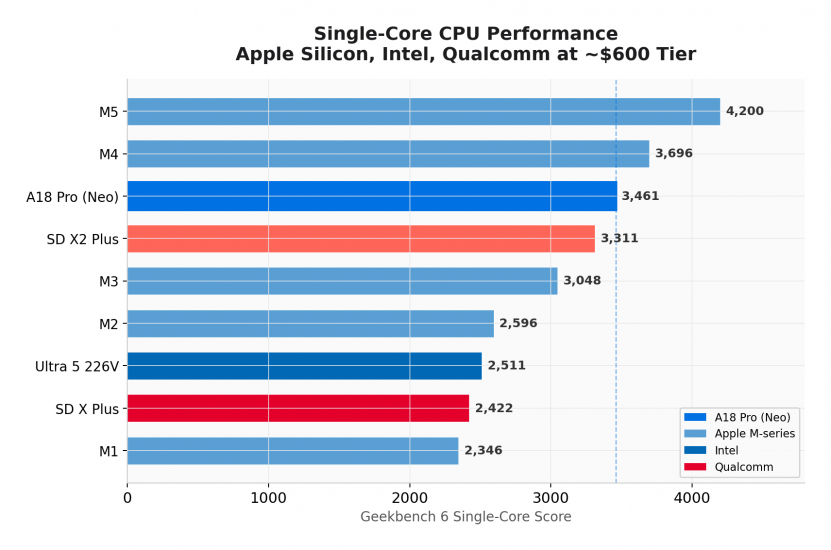
The single-core story is remarkable. The A18 Pro at 3,461 is 47% faster than the M1 (2,346), outperforms the M2 and M3, and lands within 6-7% of the M4 (3,696). Against the competition available at $600, it beats Intel’s Lunar Lake Ultra 5 226V by 38% and the Snapdragon X Plus by 43%. Only the unreleased Snapdragon X2 Plus (3,311) gets close, and it’s not shipping in sub-$700 laptops yet.
For the tasks this machine is built for (web browsing, documents, streaming, light photo editing), single-core is what matters. The Neo will feel snappy.
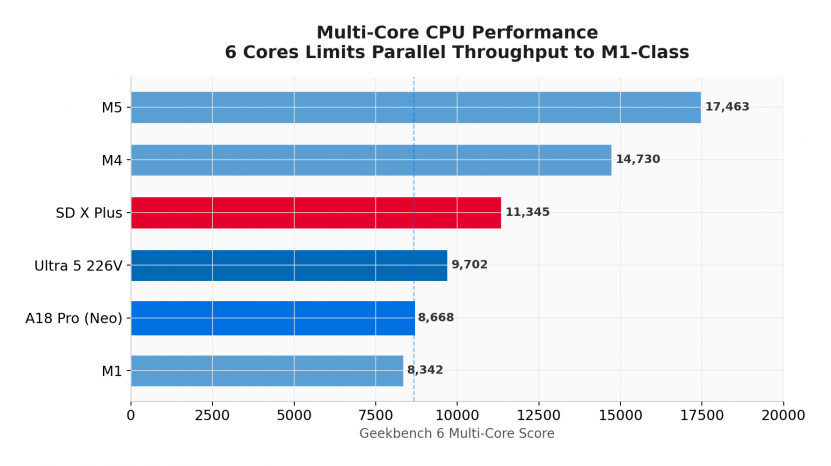
Multi-core is a different story. With only 6 cores (2 performance + 4 efficiency) versus 8-10 on competitors, the Neo’s 8,668 is essentially M1-class. It actually trails Intel’s 8-core Ultra 5 226V (9,702) and the Snapdragon X Plus (11,345) in multi-threaded workloads. The M4 Air at 14,730 is 70% higher.
If you’re compiling code, running parallel builds, or doing sustained multi-threaded work, this matters. For the Neo’s target audience, it won’t.
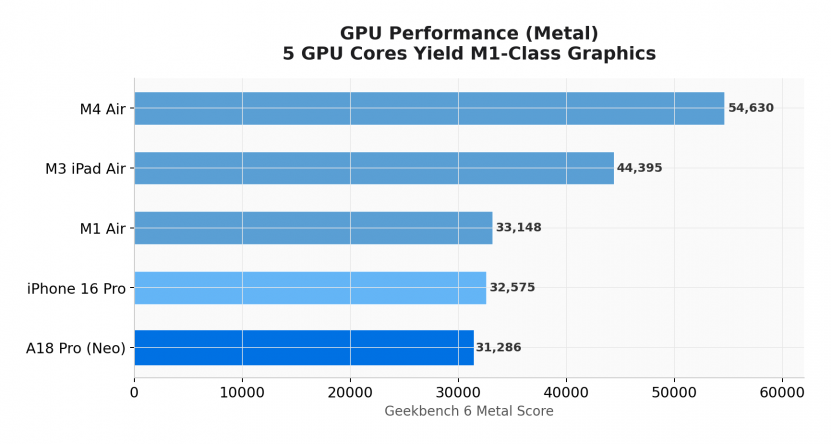
GPU performance at 31,286 (Metal) actually trails the M1 Air (33,148) slightly, despite the newer architecture. Five GPU cores versus the M1’s seven or eight means fewer parallel shader units. The M4 Air’s 54,630 is 75% higher. GPU-intensive work (video editing, 3D, gaming) is clearly not the Neo’s territory.
Architecture: Is the A18 Pro Really “Just a Phone Chip”?
The internet discourse has centered on whether an “iPhone chip” belongs in a Mac. This framing is architecturally misleading.
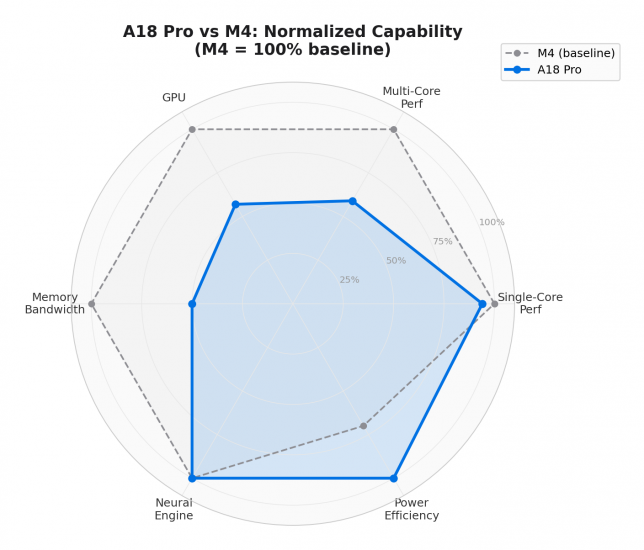
The A18 Pro and M4 share the same DNA at the core level. Both are built on the ARMv9.2-A instruction set, both use Apple’s custom Everest performance cores and Sawtooth efficiency cores, and both are fabricated on TSMC’s N3E 3nm process. When you normalize Geekbench single-core scores by clock speed, you get approximately 857 points per GHz for both chips. The IPC (instructions per clock) is essentially identical.
They also share the same GPU shader core architecture (with hardware ray tracing and mesh shading) and the same 16-core Neural Engine rated at 35 TOPS. If Apple had branded the A18 Pro as “M4 Lite,” nobody would have blinked.
Where they genuinely differ is at the system level, and these differences matter:
| Attribute | A18 Pro | M4 |
|---|---|---|
| CPU cores | 2P + 4E (6 total) | 4P + 6E (10 total) |
| GPU cores | 5 | 10 |
| P-core clock | 4.04 GHz | 4.40 GHz |
| Memory bandwidth | 60 GB/s | 120 GB/s |
| System Level Cache | 24 MB | 16 MB* |
| Thermal envelope | ~10W peak | ~20-25W sustained |
| I/O | USB 3 + USB 2 | Thunderbolt 4, PCIe 4.0 |
* Apple does not officially publish full cache hierarchies. SLC figures from cpu-monkey.com and nanoreview.net.
The memory bandwidth gap (60 vs 120 GB/s, a full 2x) is the most consequential difference. It limits any workload that’s memory-bound: large matrix operations, high-bitrate video encoding, GPU-intensive rendering. The A18 Pro partially compensates with a larger System Level Cache (24 MB vs the M4’s reported 16 MB), which reduces how often it needs to hit main memory.
The thermal difference also matters. The A18 Pro was designed for an iPhone, where sustained power is roughly 4W. The Neo’s larger fanless chassis allows somewhat more thermal headroom, but under prolonged multi-core loads it will throttle sooner than an M4 in a MacBook Air with its dedicated heatsink.
Bottom line: “Baby M4” is a useful shorthand. The shared core design means everyday responsiveness is M4-class. The system-level differences (bandwidth, thermals, I/O) mean sustained workloads are not.
Silicon Economics: How Apple Hits $599
The Neo’s price becomes less surprising when you understand the chip economics. The A18 Pro’s die measures approximately 105 mm² on TSMC N3E, confirmed by TechInsights die photography. That’s small. And small means cheap.
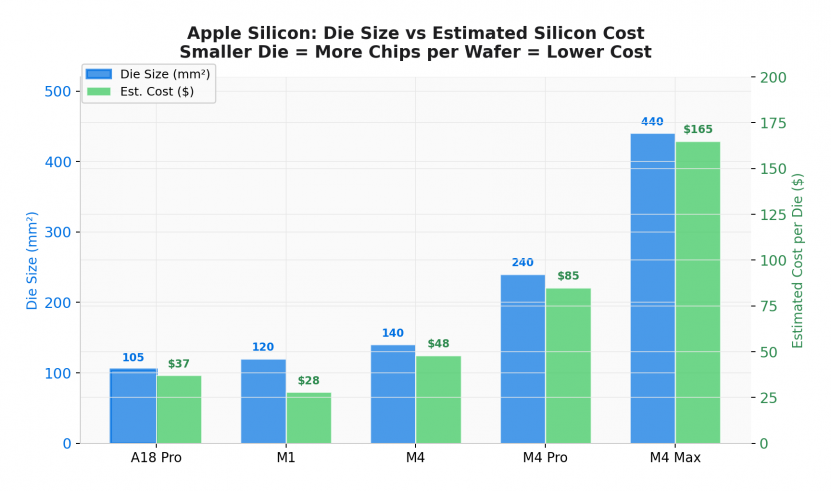
At 105 mm², the A18 Pro is 25% smaller than the M4 (~140 mm²) and 76% smaller than the M4 Max (~440 mm²). Smaller dies yield dramatically more chips per wafer and have higher yield rates because there’s less silicon for defects to land on.
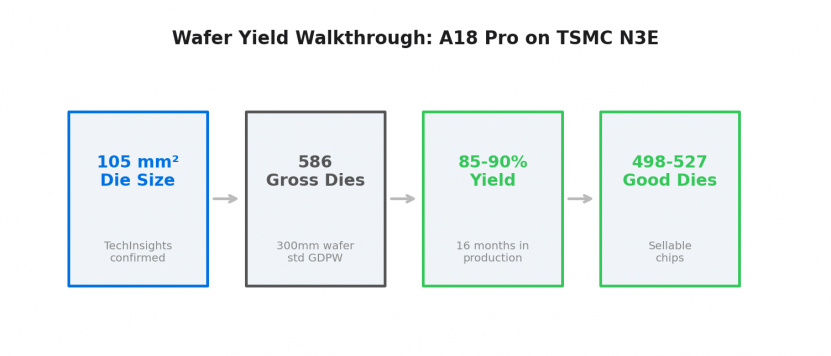
Here’s the math. A standard 300mm TSMC wafer produces approximately 586 gross dies at 105 mm² (per Arete Research). After 16 months of production maturity on N3E, yields are estimated at 85-90%, giving 498-527 good dies per wafer. At Apple’s estimated wafer cost of $18,000-$20,000 (per Ben Bajarin/Creative Strategies and Morgan Stanley), that works out to $34-40 per die before packaging and test. Fully loaded: roughly $38-47 per SoC.
Compare that to an M4 at ~140 mm² yielding approximately 430 gross dies, or an M4 Max at ~440 mm² yielding maybe 130. The A18 Pro costs Apple roughly one-third what an M4 costs and one-quarter what an M4 Max costs in raw silicon.
The real kicker: Apple ships approximately 230 million iPhones annually. The A18 Pro has been in volume production since September 2024. All mask costs ($10-20M for a 3nm EUV tapeout) and design engineering were amortized across hundreds of millions of units before a single Neo shipped. The marginal cost to Apple of routing A18 Pro dies into the Neo is wafer cost plus packaging. Zero incremental R&D.
The Neo may also absorb binned A18 Pro dies that failed their sixth GPU core during iPhone production. The Neo ships with 5 GPU cores; binned dies are perfectly suitable. This is standard industry practice (AMD and Nvidia do the same) and further improves Apple’s effective yield.
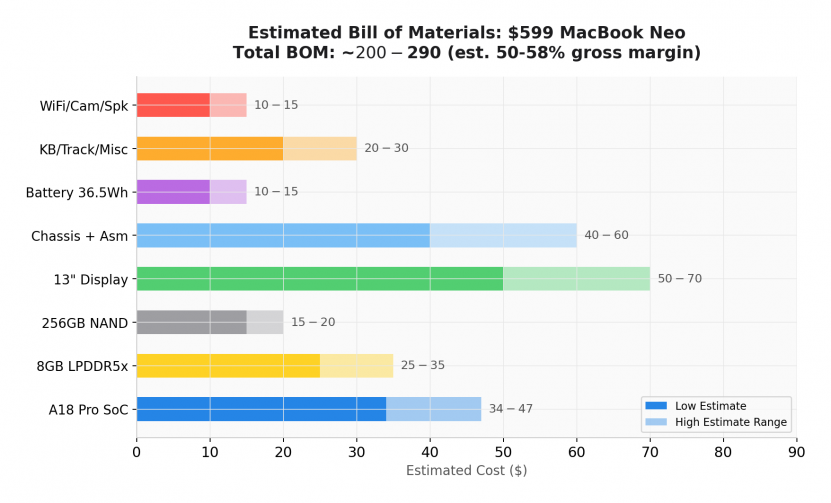
Adding up the full estimated BOM (SoC, memory, storage, display, chassis, battery, keyboard, wireless), the total lands at roughly $200-290. At $599 retail, that implies approximately 50-58% gross margin before R&D, marketing, and distribution. This is consistent with Apple’s company-wide gross margin of 47% on $436 billion in revenue. The Neo is not a loss leader. It’s a profitable product.
The 2026 RAM Shortage: Why 8GB Is Strategic, Not Just Cheap
The most common criticism of the MacBook Neo is the 8GB RAM ceiling with no upgrade path. Every Windows and Qualcomm competitor at this price ships with 16GB. Apple’s choice looks stingy until you understand the 2026 DRAM market.
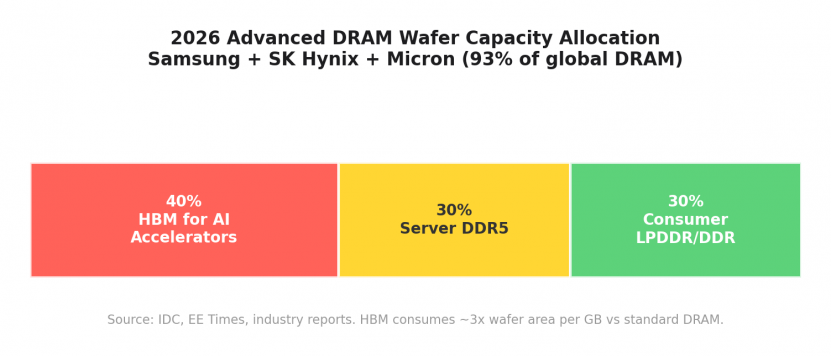
The 2026 DRAM shortage is not a typical supply/demand cycle. It is a structural reallocation of global memory fabrication capacity toward AI infrastructure. The mechanism works like this:
High Bandwidth Memory (HBM), the DRAM used in AI accelerators like Nvidia’s H100/B200 GPUs, consumes approximately 3x the wafer area per gigabyte compared to standard DDR5 or LPDDR5x. This has been confirmed by Micron executives and independently by EE Times. HBM stacks require larger dies optimized for Through-Silicon Via interconnects, and yields for 12-high stacking run only 50-60%.
Samsung, SK Hynix, and Micron control 93% of global DRAM production. All three have aggressively reallocated capacity: up to 40% of advanced wafer output now goes to HBM. Micron exited the consumer memory market entirely in December 2025. As IDC put it: “Every wafer allocated to an HBM stack for an Nvidia GPU is a wafer denied to the LPDDR5X module of a mid-range smartphone or the SSD of a consumer laptop.”
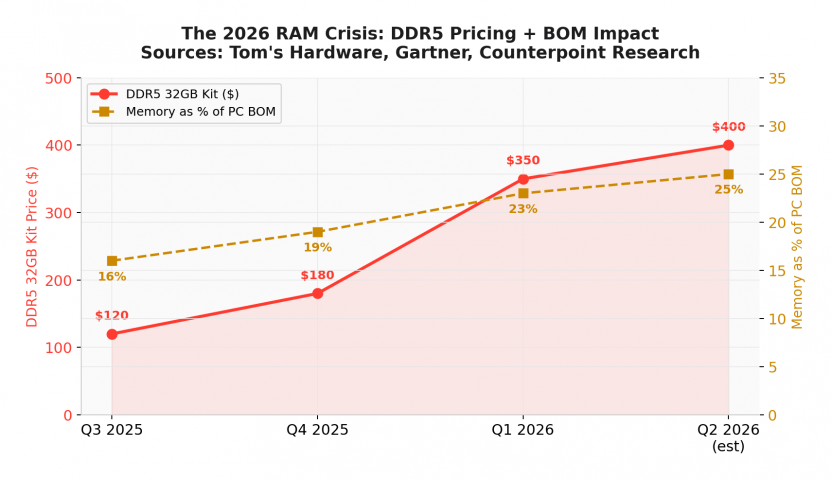
The pricing tells the story. DDR5 32GB kits that cost $120 in Q3 2025 hit $350 by Q1 2026. Memory’s share of a PC’s bill of materials rose from 16% to 23% (Gartner). TrendForce projects a 90-95% quarter-over-quarter jump in PC DRAM contract prices for Q1 2026. Data centers will consume 70% of all memory chips manufactured in 2026.
The downstream effects are severe. Gartner projects global PC shipments will fall 10.4% in 2026, with average prices rising 17%. Lenovo, Dell, HP, Acer, and ASUS have confirmed 15-20% price hikes. Gartner’s projection: “The sub-$500 entry-level PC segment will disappear by 2028.”
This is the context that makes Apple’s 8GB choice strategically interesting, not just cheap:
Cost savings are real but not the whole story. At shortage pricing, 8GB of LPDDR5x costs Apple roughly $25-35. Doubling to 16GB would add $25-35 per unit. On a $599 product that’s significant, but Apple’s 47% gross margin on $436B revenue means an extra $30 is absorbable. This isn’t purely forced by economics.
The memory controller is a genuine constraint. The A18 Pro was designed for the iPhone 16 Pro, which has always shipped with 8GB. The LPDDR5x controller is configured for that package. Upgrading to 16GB would require different memory packaging and PCB routing. Apple could have designed around this, but chose not to for a first-generation budget product.
The shortage creates a pricing umbrella. As competitor laptop prices rise 15-20%, Apple’s fixed $599 becomes more competitive every month without Apple doing anything. A $600 Windows laptop that shipped with 16GB in mid-2025 now costs $700-750 for the same specs. Apple’s decision to halve the RAM halves its exposure to the shortage while competitors eat the full price increase.
The ecosystem math works. A Neo buyer who subscribes to iCloud+ and Apple One generates $240-480 in services revenue over a 2-year device lifecycle. At those numbers, the Neo’s hardware margin matters less than converting a Chromebook user into the Apple ecosystem.
Who Should (and Shouldn’t) Buy This
The MacBook Neo excels at: web browsing, email, document editing, streaming, messaging, light photo work, and running Apple Intelligence on-device. Single-core performance faster than any Mac until the M3 generation means everyday tasks will feel snappy.
It is not for: development work, content creation, video editing, virtual machines, heavy multitasking, or anything that regularly exceeds ~1.5-2GB of available application memory (after macOS overhead). The I/O is also a genuine limitation: one USB 2.0 port is functionally useless for data transfer, no Thunderbolt means no fast external storage, and charging occupies your only USB 3 port.
The $500 gap to the MacBook Air ($1,099) is enormous, but so is what it buys: 2x RAM, 2x multi-core performance, Thunderbolt, MagSafe, backlit keyboard, P3 display, Wi-Fi 7, and a 12MP camera. If you can afford the Air, buy the Air. The Neo exists for people where $1,099 is simply not an option.
The Bottom Line
The MacBook Neo is a genuinely impressive piece of engineering at an unprecedented Apple price point, strategically timed to exploit a market in crisis. The A18 Pro is not a compromise chip. It is the same core architecture as the M4, running at M3-to-M4 class performance for single-threaded work. Apple reused mature iPhone silicon at massive scale, eliminated incremental R&D cost, and shipped a product with healthy margins at $599.
The defining constraint is the 8GB memory ceiling, not the processor. That ceiling is a product of engineering constraint (the A18 Pro’s memory controller), market economics (DRAM shortage pricing), and strategic calculation (ecosystem conversion at maximum volume). It will age poorly, it is not upgradeable, and Apple knows this. The second-generation Neo with 12GB or 16GB is already the obvious product.
But right now, in March 2026, with sub-$500 PCs disappearing and average laptop prices climbing 17%, a $599 MacBook with M3-class single-core performance, an aluminum chassis, and 16 hours of battery life is the most interesting thing Apple has shipped in years. Not because it’s the best Mac. Because it’s the most strategically significant one.
Sources: Apple Newsroom, MacRumors (March 5, 2026 benchmarks), Geekbench 6 Browser, TechInsights die analysis, Ben Bajarin/Creative Strategies (wafer cost analysis), Tom’s Hardware, IDC Global Memory Shortage Crisis Report (Feb 2026), Gartner PC Market Forecast, EE Times (“The Great Memory Stockpile,” Jan 2026), IEEE Spectrum, Network World, TrendForce, Counterpoint Research, AppleInsider, Six Colors. Estimated figures are noted as such and rely on public industry analysis and standard semiconductor cost modeling.