Category Archives: Gadgets and Tech

The History of ThinkPad: From IBM’s Bento Box to Lenovo’s Portable Workstations

A hand reaching across the keyboard of a ThinkPad X220, with the index finger near the T and 5 keys and the red TrackPoint pointing-stick nub visible just below between the G, H, and B keys. Lenovo logo on the left of the palm rest, ThinkPad logo on the right, X220 model name on the bezel.

Note: this post is published but still in progress. Spot something missing or amiss? Comment at the end 👍. This is a long article. If you just want three paragraphs, this is it: Few laptop families display their lineage as visibly as the ThinkPad. Since IBM introduced the ThinkPad notebook lineup in 1992, the brand has survived more than three decades, a change of corporate ownership, and repeated shifts in what a portable computer is expected to do. Put a

The BeBox: One of the Most Beautifully Overbuilt Computers of the 1990s

Late 2000. There is a grey and blue tower PC on my dorm-room desk like nothing anybody who walks into the room has ever seen. The Be logo on the front, a 3.5″ floppy peeking out the bottom of the drive bays, and the vertical grille that hides two columns of green LEDs (blinkenlights) dancing with the CPU load.  I paid $400 for it in two installments of $200 to a guy named Danan, about $745 inflation-adjusted to 2026. That

Chuwi MiniBook X vs MacBook Neo: The $399 Laptop That Refuses to Throttle

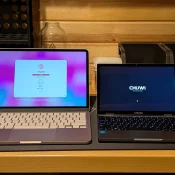
Disclosure: I purchased this Chuwi MiniBook X with my own money (~$399 from Amazon). See also: my MacBook Neo review and full Neo benchmark analysis. The $399 Laptop That Refuses to Throttle In my MacBook Neo review, I wrote that after 60 seconds of sustained CPU load, the Neo “drops to phone-class performance that a $400 Windows laptop can match.” A reader could reasonably wonder: does a $400 Windows laptop actually deliver? I had a Chuwi MiniBook X on hand

Can MacBook Neo Run Claude Code?

So in updating my MacBook Neo review with some additional stress testing and thermal testing, I came across some interesting results that begged the question: “Can it run Claude?” If you’re a gamer, that probably triggers the old “Can it run Crysis?” reflex. For those who don’t remember (or weren’t there), Crysis was the 2007 PC game that became the de facto hardware torture test. If your rig could run Crysis, it could run anything. It was a rite of

I Asked Claude What Hardware It Wanted. It Told Me.

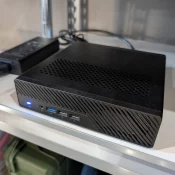
NoteTL;DR Summary: After buying the 32GB / 1TB Minisforum MS-01 from Newegg for $1,016.58 on February 8, 2026 and running it off-grid on solar in rural Missouri, I think it is one of the best Proxmox setups you can build if you care about low idle power, serious networking, and headless management. It has been rock solid and my trusty little box idles around 13W-35W while running Home Assistant, a solar poller, SearXNG, and Open WebUI. For current pricing Check

How to Allocate VRAM on AMD Strix Halo for LLMs and AI Workloads

If you have a Ryzen AI Max+ 395 (Strix Halo) system with 128GB of RAM and you’re wondering why your local LLM host (be it LM Studio, Ollama, or whatever) can’t see most of that memory, this is the fix. AMD’s unified memory architecture means your CPU and GPU share the same physical RAM, but Windows needs to be told how much of it the GPU is allowed to use. By default, it’s VERY conservative. More info below and how

Every Apple CPU Compared: M1 Through M5 Max (All Variants)

TL;DR: this page is meant to list every Apple Silicon chip from the M1 through the M5 Max, including all the lower-spec binned variants Apple buries in the fine print, with verified specs, practical buying advice, and a dedicated section on which chips can actually run local AI models. Inspired by the popular r/mac comparison table, expanded with official Apple sources, all binned variants, and honest flagging of estimated values. Bookmark it. I will keep it updated. The M5 Max

Samsung Care+ Charge on Credit Card or Bank Statement: What It Is [SOLVED]

Short answer: Samsung Care+ is Samsung’s official device protection plan, similar to AppleCare. If you see a charge labeled “Samsung Care+” on your credit card or bank statement, it is a monthly subscription fee for coverage on one of your Samsung devices. The tricky part? The statement just says “Samsung Care+” with no mention of which device it covers. If you own multiple Samsung products, or if a family member added the plan, that $13 (or $3, $5, $8, $11)

« Older Entries