How I Used AI to Help Research Used Cars (and Saved $5,000 Over Carvana)
We recently bought a used 2025 Chevrolet Blazer EV RS AWD for $29,500 from a dealer in Muskogee, Oklahoma. It came loaded with heated and ventilated seats, Super Cruise, a head-up display, leather interior, and the RS sport package. The two Carvana listings we started with? $34,180 and $35,280 delivered for a much lower trim. That’s ~$5,000+ savings for a few hours research.
Here is how we used Claude Code and Codex (AI coding tools from Anthropic and OpenAI) to research the used EV market, the surprisingly simple mistakes the AI made that we easily caught, and what we learned about buying a used car with AI as a research assistant.
For me, car buying has always been a little bit of a passion and an art form. My dad was an expert negotiator and over the years I have been honing my car buying skills.
NOTE: if you don’t enjoy the process of haggling for a vehicle, that is TOTALLY understandable! This article is just meant for people that don’t mind putting in some extra time (and potentially experiencing some frustration) to get not just a good deal but a great deal.
Oldschool vs modern day (aka Why AI for Car Shopping?)
In 2016 when shopping for a 200 series Land Cruiser for a family member, I emailed all the various dealerships in surrounding areas, asked for their best prices and then repeated the process with dealer vs dealer until it became clear which dealerships really wanted to make a sale. In that instance I believe we ended up saving about 6% beyond a good starting offer from a deal, and way more compared to the most expensive dealers. Not for a little time spent over a few days.
Side note about dealerships (or as some people call them stealerships): In my experience generally with new vehicles it is large dealerships with high volume that have the capability to potentially discount, or occasionally small dealerships that just really need to get a car off the lot. With used vehicles the situation can vary widely and there is potentially a lot more room to negotiate. What follows is primarily that used market where a little shopping around can save you a TON of money.
So now, rather than calling around… a lot of that initial research can potentially be automated with research tools (be they AI or other methods). According to a CarEdge study, roughly 1 in 4 car buyers are now using AI tools like ChatGPT during their search. A Cars.com survey found that 44% of shoppers have already used AI-powered tools during the buying process. The appeal is obvious: AI can process dozens of listings across multiple sites, compare specs, check pricing data, and organize it all into a format you can actually use.
But remember AI makes mistakes. And if you trust those mistakes without checking, you could end up buying a car that is missing features you thought it had. More on that in a minute.
The Reference Point: Two Carvana Listings
My wife and I were shopping for a used Blazer EV. There were specific reasons that is what we wanted and we had some requirements:
- AWD (we live in a rural area)
- Heated seats (sometimes Missouri winters are no joke and the more you can use heated seats in an EV instead of turning the full heat on, the better)
- Under 30,000 miles
- 2024 or 2025 model year
- No major CARFAX damage
Carvana had two promising 2025 LT AWD units:
- White, 14,086 miles – $32,590 + $1,590 shipping = $34,180 delivered. Included the Comfort & Convenience Package, panoramic sunroof, all-weather liners, and other extras. Original MSRP was $54,300.
- Galaxy Gray, 10,450 miles – $33,990 + $1,290 shipping = $35,280 delivered. Had the Comfort & Convenience Package but fewer extras than the white one.
Obviously the Carvana price is usually higher than the best deals around, but sometimes there are a few hidden gems and the Carvana experience can potentially be smooth: no haggling, delivery to your door, 7-day return policy. I get the appeal. But were these prices actually good? That is where AI came in. Also, we were working against the clock because with current fuel prices and the war in Iran it became obvious that used EVs are selling very quickly. The WSJ and other news sources have been writing about it regularly.
The Research Prompt
I use Claude Code (Anthropic’s CLI tool for Claude) for a lot of automated work. It can browse websites (specifically I like to use Playwright so it gets the actual site, not snippets like claude.ai or ChatGPT frequently rely on), run searches, organize data, and work through multi-step research tasks. I wrote a detailed prompt asking it to:
- Scrape comparable listings from Carvana, CarGurus, Cars.com, and AutoTrader
- Check dealer inventory for new and used units within 300 miles
- Get KBB and Edmunds fair market values
- Output a comparison table sorted by total delivered cost
The prompt was specific about the constraints: LT trim minimum, AWD only, 2024-2025, under 30,000 miles, must have heated seats. I also asked it to optionally factor in transport costs at $1.50/mile to our ZIP code.
As mentioned above, Claude Code used Playwright (a browser automation tool) to scrape CarGurus directly, ran web searches for the sites that blocked automated browsing, and pulled KBB/Edmunds pricing data. It even launched a background research agent to check fair market values while it scraped listings.
You can do these same things with the base level claude.ai or chatgpt models, but just be aware their website searching can be a little limited since they frequently deal with data snippets rather than rendering entire pages.
What the AI Found
The results were eye-opening. CarGurus alone had 13 LT/2LT AWD listings and 9 RS AWD listings, almost all priced well below the Carvana units. There were a LOT of results but here are some highlights:
| Vehicle | Miles | Price | Est. Delivered | vs. Carvana |
|---|---|---|---|---|
| 2024 2LT AWD – Houston, TX | 19,644 | $21,587 | $22,712 | Saves $11,468 |
| 2024 2LT AWD – Saukville, WI | 11,807 | $23,398 | $24,373 | Saves $9,807 |
| 2024 RS AWD – Marysville, OH | 23,510 | $25,000 | $25,900 | Saves $8,280 |
| 2024 2LT AWD – Middlesboro, KY | 2,147 | $25,280 | $26,105 | Saves $8,075 |
| Our Carvana baseline (white, 2025 LT) | 14,086 | $32,590 | $34,180 | Baseline |
Every single comparable listing beat both Carvana candidates on delivered price. Some by over $10,000. The AI also found that federal EV tax credits expired in September 2025, that KBB private party value for a 2024 LT was only $22,100-$24,000, and that the Blazer EV has been depreciating at 35-50% in the first year due to aggressive new-car discounts, multiple recalls, and the broader EV market correction.
Again, you do have to watch out for dealers that try to add things on etc. but those are pretty low starting points.
This is where Carvana’s no-haggle model can work against you. The convenience premium is real, and some buyers are happy to pay it. But you should at least know what it is before you decide.
The Mistakes the AI Made
At this point in the evolution of AI, it still makes a lot of mistakes.
Claude Code initially told me that heated seats are standard on all Blazer EV LT/2LT AWD models. That is absolutely incorrect. I already knew from my own research that heated seats on the LT require the optional Comfort & Convenience Package or similar upgrade. So when Claude Code stated otherwise with full confidence, it was an immediate red flag.
To confirm, I pulled up one of the listings it had flagged as the “best 2025 deal” — a unit in Lakeland, Florida at $25,594. I searched the dealer’s page for “heated” and got zero results. No heated seats on a vehicle the AI had just told me included them as standard.
Heated front seats on the Blazer EV LT require the optional Comfort & Convenience Package ($2,495). They are not standard equipment. The RS trim includes heated and ventilated seats as standard, but the base LT does not. This is exactly the kind of detail that sounds plausible to an AI but can cost you real money if you do not verify it.
To its credit, once I flagged the error, Claude Code went back and individually verified every listing. It clicked into each CarGurus detail page, checked the options list, extracted VINs, and confirmed which units actually had the C&C package. It even used JavaScript to batch-fetch seven listing pages at once to check for heated seats across all of them. The correction process was thorough. But the initial claim was wrong, and if I had not caught it, I could have ended up with a car that did not have heated seats.
Lesson: AI is a research assistant, not an authority. Always verify the details that matter to you, especially features that are options vs. standard equipment.
The second issue was subtler but arguably more important. Independent research led me to realize that 2025 models are generally more stable on software than the 2024s. The 2024 Blazer EV had a well-documented stop-sale in late 2023 due to infotainment issues, and GM didn’t resume sales until March 2024 after a major software update. Some 2024 units also had a gateway module issue that blocked over-the-air (OTA) updates entirely. Meanwhile, MotorTrend’s long-term 2025 review reported the infotainment never crashed over an entire year of testing. (Spoiler alert, our 2025 has been epic and solid when it comes to software so far AND the process of transferring everything from previous owner to use was very painless via onstar and then just easy steps )
Neither Claude Code nor Codex flagged any of this when happily recommending 2024 models. Whether that was poor prompting on my part or a gap in the AI’s knowledge, the result is the same: independent research steered me toward 2025 models, and I am glad it did. You can absolutely get a good 2024, but for my situation the 2025’s software maturity was worth the peace of mind.
As such, for ANY vehicle you’re probably going to want to both individually and via AI look for any “gotchas” on particular model years. Also of course THOROUGHLY research CARFAX reports and recall reports for any particular VIN you are interested in.
The Expanded Search
After the heated-seats correction, we expanded the search to include the RS trim (where heated seats are standard) alongside LT units with verified C&C packages. The good news: almost every 2024 “2LT” listing turned out to have the C&C package anyway. The C&C package is technically optional on the 2LT, but most 2024 2LT AWD units were sold with it bundled at launch, which explains why nearly every one we checked had it. The Lakeland unit was an outlier — a base 2025 “LT” without the package.
With the RS trim now in play, the options opened up. RS units were generally priced between $24,991 and $32,990 or up, and they came with features that are optional or unavailable on the LT: ventilated seats, a sportier exterior, larger wheels, and the option for Super Cruise.
What We Actually Bought
After all that research, my wife found the one. She was browsing listings on her own (because car buying is a team sport) and spotted a 2025 Blazer EV RS AWD at a dealer in Muskogee, Oklahoma.
2025 Chevrolet Blazer EV AWD RS — Galaxy Gray Metallic
- ~19K miles, 1-owner, clean CARFAX
- RS Convenience and Driver Confidence Package
- Super Cruise (hands-free highway driving)
- Heated and ventilated front seats, heated rear seats, heated steering wheel
- Head-up display, leather interior, 20″+ wheels
- 283-mile electric range
The online price was $29,911. I called the salesman, got additional photos texted over (the vehicle was so new on the lot it only had three photos), and we negotiated back and forth until we agreed on $29,500 out the door. More on how that played out at the dealership in a moment.
It checked almost every box. AWD, heated seats, the right color, a higher trim than we originally planned, and a price nearly $5,000 less than the Carvana LT units. The one compromise? It had a panoramic sunroof, which we would have preferred to skip (they can be noisy and one more thing to potentially leak down the road). I am also not a huge fan of the larger diameter wheels and skinny tires since they hurt efficiency, but that is what the RS comes with and they are easy to replace. However, at that price and with that equipment list, it was an easy call and EV sales seemed to be accelerating on a daily basis.
The drive to Muskogee took a few hours, but we didn’t mind. It is not too far from where I grew up and we still have family in the area, so we made a day of it. We did the deal, drove it home, and the savings over the Carvana price is much appreciated in these inflationary days.
A Fair Word About Carvana (and Dealers)
I do not want to paint this as “Carvana bad, dealers good.” It is more nuanced than that.
Carvana’s strengths are real: No pressure, no surprise fees, delivered to your door, 7-day return policy if you do not like it. For people who hate the dealership experience, that has genuine value. And their prices are not always high. Sometimes they are competitive.
Dealers have their own problems: Some advertise low prices and then add thousands in fees at signing. Doc fees, “market adjustments,” dealer-installed accessories you did not ask for. The listing price is not always the out-the-door price.
Our own experience was a case study in why you get everything confirmed in writing before you make the drive. The salesman was young and new to the job. When we agreed on $29,500 out the door, he hadn’t confirmed with his manager whether that was a cash or financed price, and hadn’t clarified the doc fee situation.
When we showed up at the dealership, the manager had a different number in mind. Fees materialized. The total climbed past $32,000. I told them there was no way I was paying that after being quoted $29,500, and I was literally at the door ready to walk out, three of them and one of me. To his credit, the salesman was honest and confirmed the $29,500 quote he had given me. The manager relented. We signed at $29,500 out the door, no additional fees. My wife picked up Chick-fil-A sweet teas for everyone while we filled out the paperwork. All amicable in the end, and kudos to them for standing by their salesman’s word.
The point is not which channel is better. The point is that you need to know what the market actually looks like before you commit. Whether you buy from Carvana, a dealer, or a private seller, understanding the price range gives you leverage or at least peace of mind and the ability to walk away if the price obviously isn’t right.
What I Would Do Differently
- Verify standard vs. optional features immediately. Do not take the AI’s word for it. Pull up the manufacturer’s build sheet or a spec comparison on Edmunds before you start filtering listings.
- Check for any gotchas or perks on particular model years. For a Blazer EV I would shoot for a 2025 or 2026. For a Ford Lightning I might actually strive for a 2023-2024 as they started deleting features as time went on!
- Include more trims from the start. We initially limited the search to LT only. Opening it up to the RS earlier would have shown us better-equipped vehicles at similar prices sooner.
- Get transport quotes early. Our $1.50/mile estimate was reasonable but actual quotes vary. For distant listings, get a real quote before deciding it is worth pursuing.
- Get all details in writing before you make the trek. This time it worked out in my favor, but usually it doesn’t. Have the out-the-door price, fees, and payment method confirmed via text or email before you set foot in the dealership.
Tools Used
- Claude Code (Anthropic) — The main research workhorse. Browsed listing sites, extracted data, built comparison tables, verified features on individual listings. It also pulled KBB/Edmunds fair market values and checked tax credit status.
- Codex (OpenAI) — Used as a second opinion for package/trim verification and cross-referencing data.
- CarGurus, Cars.com, AutoTrader, Edmunds, KBB — The listing sites and valuation tools that provided the raw data.
- Manual verification — The most important tool. Clicking into listings, reading dealer descriptions, searching for “heated” on feature pages, and confirming details before making decisions.
Other approaches you can check out:
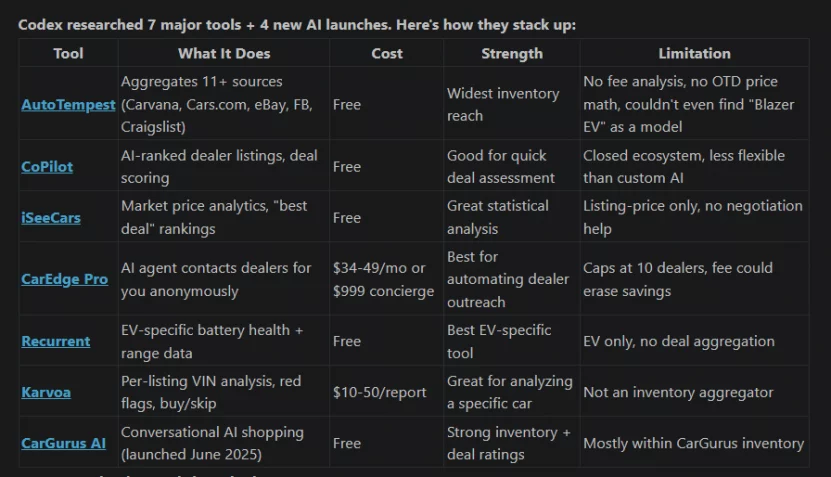
Here is a brief evaluation of some other methods
And one more that is actually quite promising!

visor.vin seems to be popular on reddit and has some cool research capabilities! I looked it up after the fact while writing this blog post, and overall it seems quite useful 👍
I have no affiliation with the visor.vin site but it is definitely something I will utilize next time. Thankfully, after seeing the results on there I am super happy with the deal that I got! 👍😉
The Bottom Line
AI tools like Claude Code and Codex can compress days of car shopping research into a couple of hours. They are not perfect, and you need to verify what they tell you. But as a way to quickly understand a market, compare dozens of listings across multiple sites, and identify which vehicles are priced right? They are hard to beat.
We started with two Carvana listings at $34-35K for a 2025 LT. We ended up with a 2025 RS at $29,500 from a dealer about 5 hours away. We had a great trip down to pick it up and had some nice sushi at my favorite sushi place in Tulsa. The vehicle was the same platform, better trim, more features, ~$5,000 less. The AI did not find that exact car for us (my wife actually did). But the research it provided gave us the confidence to know it was a good deal when we saw it.
So for the moment, nothing beats human discretion and judgment. But it is nice to have a research assistant at your beck and call!
In a future post, I will share the call script I used when contacting dealers to negotiate. It had my checklists for every point (I didn’t check every one off, but I did get most of them). Having the market data in hand made those conversations a lot more productive.
This is just one approach to car shopping. Your mileage (pun intended) may vary. The used EV market moves fast, especially with rising gas prices and shifting incentives. Do your own research, verify everything, and buy what makes sense for your situation. Happy car hunting!
PS if you have your own favorite methods or tips, I would love to hear them!