Data truncated for column ‘status’ at row 1 [SOLVED]
Recently I encountered the following error:
Data truncated for column ‘status’ at row 1
This was specifically in a PHP based web hotel/reservations app that uses MySQL for the database backend. When trying to add a new dropdown option value of ‘departed’, the form submission would always fail with the aforementioned error.
Thankfully, the solution was easy once I checked the table/field definitions. The column ‘status’ was of type enum and thus needed to have the ‘departed’ value specifically enumerated in the field definition.
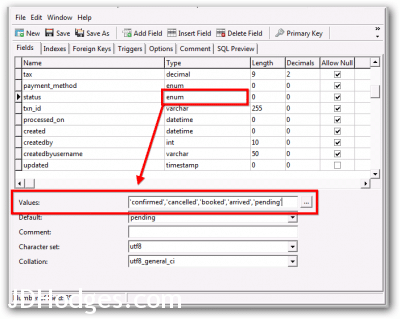
Showing the existing enum values for the status field
After adding that new value to the table field, all was well:
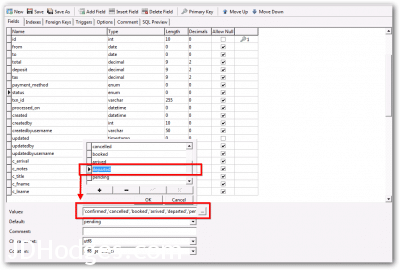
Add ‘departed’ as a new enum value for the status field
After the table change was saved, the application worked perfectly. 🙂 I also added a note in the PHP source code so that if anyone else ever needs to add a value there, they will know that the underlying table definition needs to be updated as well!
- mysql data truncated for column (13)
- data truncated for column (9)
- data truncated for column at row 1 (3)
- data truncated for column mysql (3)
- mysql data truncated for column enum (3)
- data truncated for column 'status' at row 1 (2)
- how do you adjust rows and columns on a dell laptop (2)
- data truncated for column 'nfo' at row 1 (1)
- data truncated at row 1 ,enum (1)
- sql data truncated for column (1)
bbe
Do you usually recommend increasing the column length as a first step, or do you find that switching to a different data type (like VARCHAR instead of ENUM) is a better long-term solution for this specific error?
Good question, Desain. One clarification: increasing column length doesn’t apply here, because this ENUM error isn’t really about string length. The issue is that MySQL rejects values that are not explicitly listed in the ENUM definition. In other words, the fix is to update the allowed values, not to make the column “longer.”
My rule of thumb is to keep ENUM when the set of values is small and stable, and move to a lookup table when values change regularly or multiple systems are writing to the column. I would usually skip jumping straight to free-form VARCHAR, because that solves the immediate ENUM issue but gives up database-level validation unless you add constraints elsewhere.
Thanks for the question and have a great week!
-J.D.
Getting a random truncation error right in the middle of a database migration or a strict application update can be a massive headache. 🙁 Having a quick guide that zeroes straight in on Enum mismatching and strict SQL mode behavior saves so much diagnostic time. Thanks for sharing the solution!
Thanks for sharing your thoughts, desain! I’m glad I could help and I hope you don’t run into any more database headaches 😊.
Have a great week!
-J.D.