The IRS Is Phasing Out Paper Checks: What You Need to Know
February 17, 2026
Disclaimer: This blog post is for general informational purposes only and does not constitute legal, tax, or financial advice. The author is not acting as your attorney, CPA, or tax advisor. Tax law and IRS policy are subject to change without notice, and the information presented here may be incomplete or outdated by the time you read it. You should consult a qualified tax professional or attorney regarding your specific situation before making any decisions based on this content. Reliance on any information provided in this post is solely at your own risk.
If you’ve heard that the IRS is eliminating paper checks by the end of 2026, you’re not alone. It’s a topic generating real concern, especially among taxpayers who have relied on checks for decades. Here’s what’s actually happening, what’s already changed, and what remains uncertain.
What Triggered This?
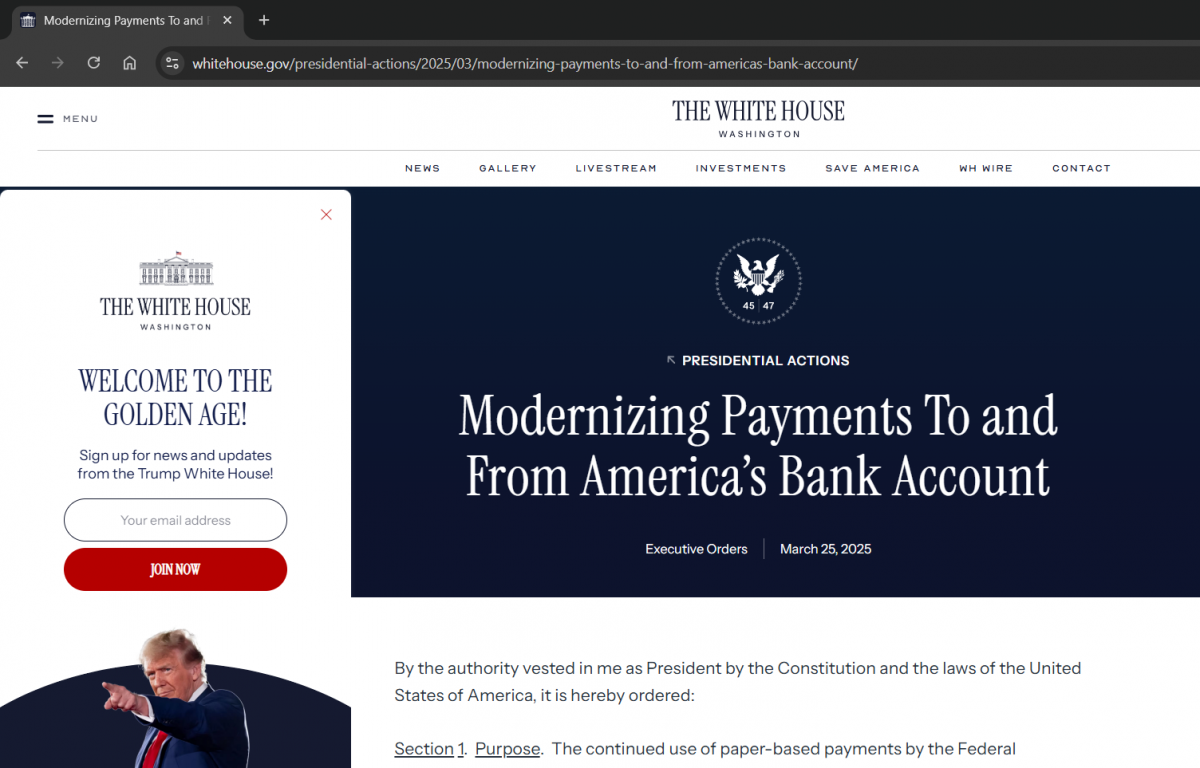
In March 2025, the President signed Executive Order 14247, titled “Modernizing Payments To and From America’s Bank Account.” The order directs the Treasury Department and the IRS to transition all federal payments, both incoming and outgoing, to electronic methods.
What Has Already Changed
Refund checks are largely gone. As of September 30, 2025, the IRS stopped issuing paper refund checks for most taxpayers. If you’re owed a refund, the IRS now expects you to receive it via direct deposit, prepaid debit card, or another electronic method. If you file without providing bank information, your return will still be accepted, but your refund could be delayed by six weeks or more while the IRS contacts you for electronic payment details.
During the 2025 filing season, 93% of individual refunds were already issued via direct deposit, so for most people this changes nothing. But for the 7% who still relied on paper checks, including seniors, unbanked individuals, and those without reliable internet access, it’s a meaningful shift. 1
What Hasn’t Changed (Yet)
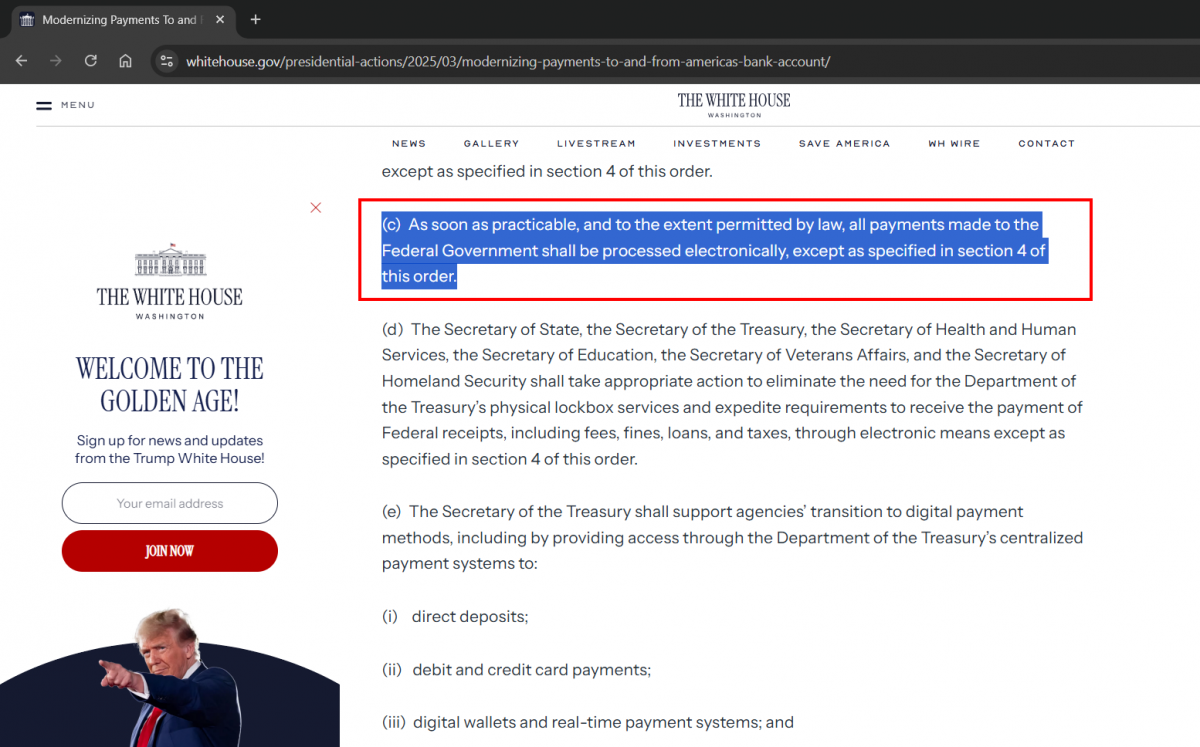
Paper check payments TO the IRS are still accepted. Despite some claims to the contrary, the IRS’s own guidance, updated as recently as January 27, 2026, confirms that checks and money orders are still being accepted for tax payments. 2 The operative language from the executive order is that incoming paper payments should be eliminated “as soon as practicable,” which is not exactly a firm deadline.
There is no announced date for when the IRS will stop accepting paper checks for tax payments. If pressed to guess, it seems likely the transition could begin in 2027, but that’s speculation, not policy.
The Broader Executive Order Problem
Regardless of where you fall politically, this situation highlights a recurring issue with executive orders: they tend to be broad directives rather than carefully crafted policy. This one is no exception. It sweeps in all federal payments without much specificity, leaving agencies to figure out the details and taxpayers to wonder what’s actually required of them.
For context, this administration has signed 240 executive orders in just over a year, putting it on pace for roughly 888 over a full term. 3 That would be more than any president since FDR. For comparison, the prior administration signed 162 across four years. 4
Whether you agree with any particular order or not, this pace raises a legitimate governance concern. Executive orders are directives, not legislation. They can be reversed by the next president, challenged in court, or simply ignored by agencies that lack the resources to implement them. Policy made this way tends to create uncertainty rather than resolve it, and this IRS situation is a textbook example.
What Should You Do?
For the 2026 filing season, taxpayers who still pay by check can continue to do so. But it’s worth preparing for the inevitable transition:
IRS Direct Pay (directpay.irs.gov) is probably the simplest option. It’s free, works directly from a checking or savings account, and does not require creating a login or registering for an account. You enter your information each time you make a payment.
Other options include paying by debit or credit card (processing fees apply), the Electronic Federal Tax Payment System (EFTPS, though this is being phased out for individual taxpayers), and Electronic Funds Withdrawal when e-filing through tax software.
Who Gets Left Behind?
The IRS says limited exceptions will be made for taxpayers facing genuine hardship, including those without access to digital banking, those with documented mental impairments, and members of religious groups with objections to electronic banking. Estate and decedent accounts are also currently exempt.
But “limited exceptions” is cold comfort for the millions of Americans, many of them elderly, who don’t have reliable internet access or who are understandably wary of transmitting their banking information online. The executive order may cite fraud prevention and cost savings as justifications, and those arguments have merit, but a forced transition with no firm timeline and vague exception criteria is a frustrating way to get there.
There’s always a chance this gets challenged or scaled back before it fully takes effect. Executive orders are not law, and they can be reversed or blocked. Here’s hoping common sense prevails and the legislature starts doing its job.
Key Links
- Executive Order 14247 (Full Text)
- IRS FAQ on the Executive Order
- IRS: What the Phaseout Means for You
- IRS Direct Pay
Citations
Disclaimer: The information in this blog post is provided “as is” without warranty of any kind. This post is for general informational purposes only and does not constitute legal, tax, or financial advice. The author makes no representations or warranties regarding the accuracy, completeness, or timeliness of the information contained herein. Tax law, IRS policy, and executive orders are subject to change, legal challenge, or reversal at any time. Always consult a qualified tax professional or attorney before making decisions about your tax obligations. The author disclaims any liability for actions taken or not taken based on the contents of this post.
Footnotes
- IRS News Release IR-2025-94 (September 23, 2025). “IRS to phase out paper tax refund checks starting with individual taxpayers.” (93% / 87 million refunds issued via direct deposit during 2025 filing season.) ↩
- IRS. “Questions and answers about Executive Order 14247.” (Updated January 27, 2026. Confirms checks and money orders still accepted for payments to the IRS.) ↩
- Ballotpedia. “Donald Trump’s executive orders and actions, 2025-2026.” (240 executive orders as of February 11, 2026.) The 888 projection is the author’s extrapolation based on the current pace across a full four-year term. ↩
- Federal Register, National Archives. “Executive Orders.” (Historical executive order counts by president: Biden 162, Trump 1st term 220, Obama 277, G.W. Bush 291, Clinton 364, Reagan 381.) ↩
Words people used to find this page:
- IRS paper check phase out 2026
- IRS no longer accepting paper checks
- IRS stop accepting checks when
- executive order 14247 paper checks
- can I still pay IRS with a check
- IRS electronic payment requirements 2026
- IRS Direct Pay how to use
- when will IRS stop taking checks
- IRS paper check ban